Welcome to Shanghai Xuanpu Electronic Technology Co., Ltd!
- Site Map
- Contact Us
- Follow WeChat

-
 简体中文
简体中文
Welcome to Shanghai Xuanpu Electronic Technology Co., Ltd!
简体中文

Hotline
+86-21-34291916
Hotline
+86-21-34291916The base of a transistor (represented by the letter B - derived from the English word Base, basic), the other two electrodes are called - C - derived from the English word Collector, and the emitter (represented by the letter E - derived from the English word collector - emitter). The junction between the base region and the emitter region becomes the emitter junction, and the junction between the base region and the collector region becomes the collector junction.
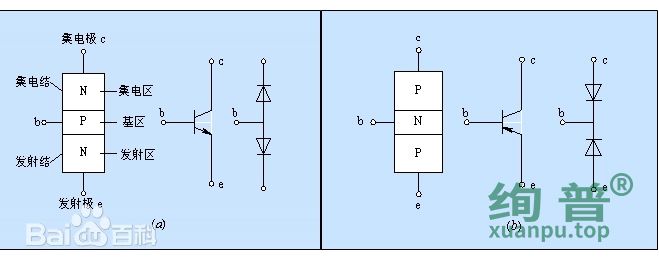
NPN transistor: composed of two N-type semiconductors and one P-type semiconductor, with the P-type semiconductor in the middle and two N-type semiconductors on both sides. The transistor is the most important device in electronic circuits, with its main functions being current amplification and switching.
PNP transistor: A transistor composed of two P-type semiconductors sandwiching one N-type semiconductor, hence it is called a PNP transistor.
1、 NPN device
NPN (negative positive) is a type of semiconductor transistor that consists of three semiconductor regions: emitter region, base region, and collector region. Among them, there is an emitter junction between the emitter region and the base region, and a collector junction between the base region and the collector region. When a forward voltage is applied to the emitter junction, current flows from the emitter region to the base region.
NPN devices have the following characteristics:
1. High current gain. Due to the current gain of NPN devices being greater than 1, they can amplify the current. This is one of the main applications of NPN devices, such as amplifiers, oscillators, etc.
2. Low input impedance. The input impedance of NPN devices is relatively low, so it has a significant impact on the signal source. This makes NPN devices unsuitable for use in circuits with high input impedance.
3. High output impedance. The output impedance of NPN devices is relatively high, which means that their output signal is easily affected by load resistance. Therefore, when using NPN devices, it is important to choose the appropriate load resistance.
4. Wide frequency response. NPN devices have a wide frequency response, making them suitable for use in high-speed circuits.
2、 PNP device
PNP (positive negative power) is a semiconductor transistor that is opposite to NPN, and its structure also includes three semiconductor regions: emitter region, base region, and collector region. Among them, there is an emitter junction between the emitter region and the base region, and a collector junction between the base region and the collector region. When a forward voltage is applied to the emitter junction, current flows from the base region to the emitter region.
PNP devices have the following characteristics:
1. Low current gain. Due to the current gain of PNP devices being less than 1, they cannot amplify current. This is one of the main applications of PNP devices, such as switch circuits, logic circuits, etc.
2. High input impedance. The input impedance of PNP devices is high, so their impact on the signal source is relatively small. This makes PNP devices suitable for use in circuits with high input impedance.
3. Low output impedance. The output impedance of PNP devices is relatively low, which means that their output signal is not easily affected by load resistance. Therefore, there is no need to choose a too precise load resistance when using PNP devices.
4. The frequency response is relatively narrow. The frequency response of PNP devices is narrow, so they are not suitable for application in high-speed circuits.
3、 Application scenarios
NPN and PNP devices have their own advantages and disadvantages in different application scenarios. NPN devices are commonly used in circuits such as audio amplifiers and RF amplifiers; In digital circuits, switching power supplies, and other circuits, PNP devices are commonly used.
In summary, although NPN and PNP devices have similar structures, their working principles and application scenarios are significantly different. In practical applications, it is necessary to choose the appropriate device type based on specific needs.
Copyright © 2023-2025 Shanghai Xuanpu Electronic Technology Co., Ltd. All rights reserved 备案号:沪ICP备19025686号-1